
Associo from a barrister's perspective
In a large commercial matter, as you head towards trial, the volume of material is enormous. The team has been reading, searching, summarising, and drafting for months or even years. By any reasonable measure a great deal of work has been done.
And yet you still have the nagging concern as you enter the crunch stage of the case: do we really have a grip on what is in this material, and on what it does to the case? And, relatedly, when is the trial bundle actually going to arrive?
The recurring pattern is something like this. The disclosure has been reviewed, and thousands of potentially relevant documents have been found. Reviewers have read documents and noted points; junior counsel have produced lists; the chronology has grown across several spreadsheets and a Word document; different members of the team have their own notes. Each of those streams of work is, on its own, careful. But the output sits across document platforms, notes, chronologies, drafts, and people's heads, and has to be repeatedly pulled together.
AI is now also in this conversation, but often adds to the fragmentation as it gives you another set of review notes without a proper home linked to the issues. A faster review without an organised home for the resulting insights still leaves you with the task of pulling all the threads together from a multitude of disconnected sources.
Two modes of work behind the question
A large part of the value the team needs to deliver in a heavy commercial matter sits in one of two modes of work:
Digesting the evidence. Investigating the evidence, identifying the passages that matter, and relating reviewed material to issues and lines of argument. This is the heaviest investment, particularly during disclosure and post-disclosure. Much of this work is done by the wider team, and much of it is sound — but it is often done in a way that does not put the relevant information at your fingertips.
Using the evidence. Drafting an opinion, pleading, advice, or skeleton argument, drawing on the output from the "digesting" stage.
Both modes are present at every stage of a heavy matter. The ratio shifts: early case review is mostly digesting, with some use for early advice; disclosure is the largest digesting exercise; the run-up to trial and the trial itself are dominantly using, with continued digesting as new material lands.
The diagnostic question — "do I really have a grip on this?" — usually means: did the digesting work give me the relevant information in a way I can easily use, or is it scattered so I still have to pull it all together? In practice, much of the heavy-lifting on a case ends up being done twice — once in working through the evidence, and again when trying to use it.
The better approach
What we are building at Associo is a way of running a matter in which the process of digesting the evidence is better organised, and accelerated by judicious use of AI. The shape is a cycle, repeated as understanding develops: search → review → organise, sitting on top of the document corpus the team has ingested.
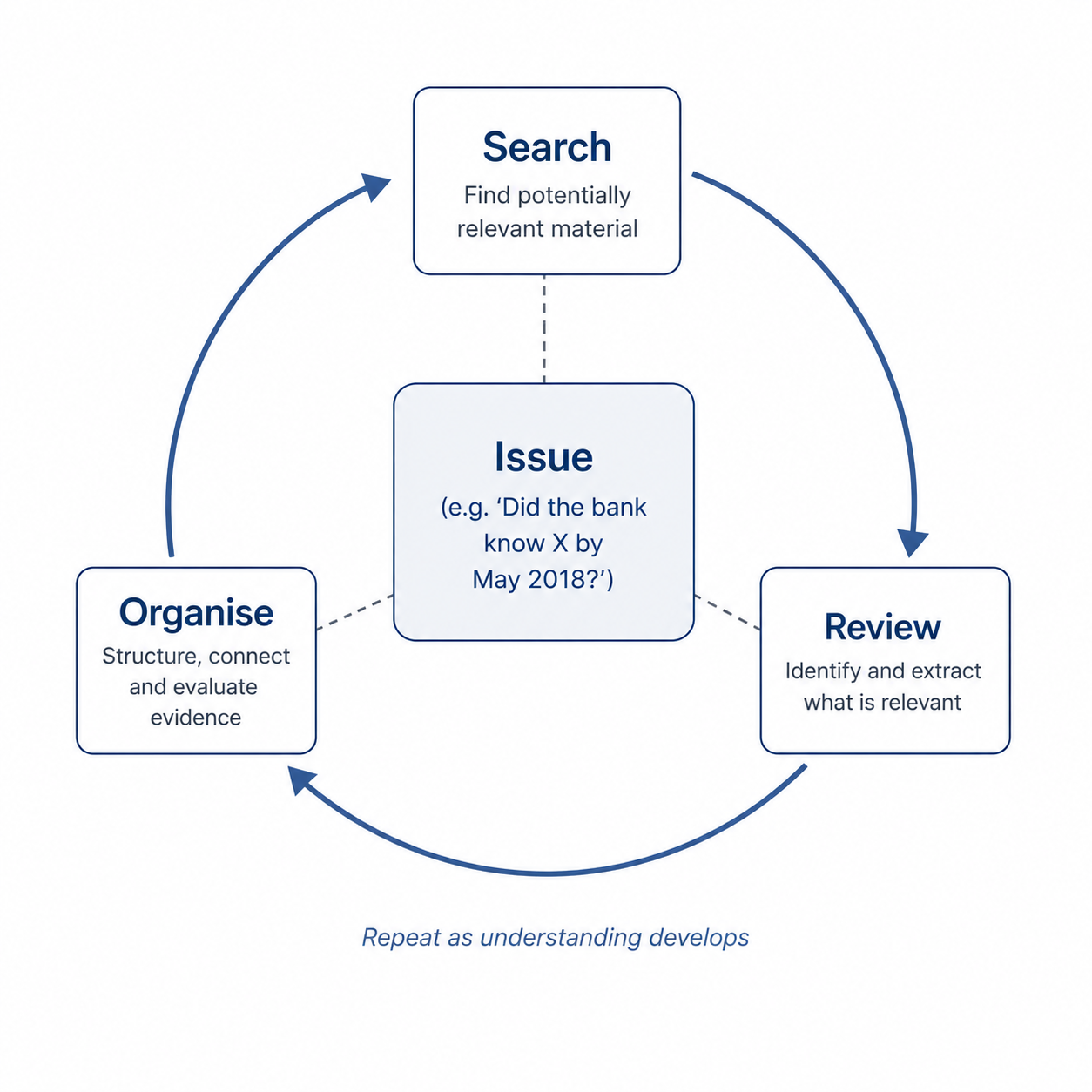
Ingest feeds the cycle; search, review, and organise repeat as understanding develops.
Three things make that cycle in Associo different from doing the same work across a stack of separate tools.
First, everything sits in one place. Documents, extracts, issues, propositions, tags, tasks, and the team's own notes and judgements all sit together. The evidence is connected to issues in a way that makes it easy to access and use what matters on each issue.
Second, AI is used in a targeted and reliable way, not as a general substitute for thinking. A focused search produces a result set that AI can read for you and answer questions on, with citations back to the documents. A larger pool — thousands of documents if necessary — can be read by AI following your instructions to rapidly produce a smaller set of genuinely relevant documents with the key quotes pulled out for you. The team's judgement remains central and captured in your notes on the documents and issues.
Third, organising happens organically as the team digests the information. The reviewed material is easily gathered into "buckets" as it is found and reviewed, with easy access to high value material (e.g. documents you commented on or documents given a defined term like "the January 2022 Prospectus"). Increasingly specific connections are made between evidence and issues as you develop your understanding of how everything fits together. The case structure is visible to the whole team — with weak points and gaps apparent as features of the picture rather than as silent omissions.
The result is that you can build and test the case as you go, and as you approach trial you are not faced with a titanic struggle to get to grips with a mass of disorganised material.
From counsel's perspective, you also don't have to wait for the trial bundle to start preparing the case, because you already have all the documents that will be in the trial bundle with control numbers. When a shared electronic trial bundle goes live, we merge in the trial bundle references and hyperlinks and all your existing analysis takes you straight to the corresponding documents in the trial bundle.
Bespoke automation
We also have a development team who can use AI and automation to do useful bespoke tasks that it would be too slow or expensive for your team to do manually. For example: reviewing 100 near-duplicates of a key document, precisely dating them by reviewing parent emails and other indicators, and summarising relevant differences between each document and (i) the previous version and (ii) the final version.
Who pays for this
Typically, the solicitors pick up the bill to provide Associo for the whole team, and pass the cost on to the client.
If this resonates
If this sounds interesting, it would be good to compare notes. A short call to walk through how this works in practice and discuss whether it would be useful on a current matter is usually a good first step, with or without your wider team. You can schedule a call using THIS LINK.